AI Engineer Code Summit 2026: Agentic Coding in San Francisco
A verified guide to the application-based AI Engineer Code Summit, November 10–12 in San Francisco, covering coding agents, evaluations and attendance decisions.
Verified 16 October 2026. This is an independent event guide. Confirmed organizer details are identified below; attendance and preparation suggestions are editorial advice.
Dates, venue and admission status
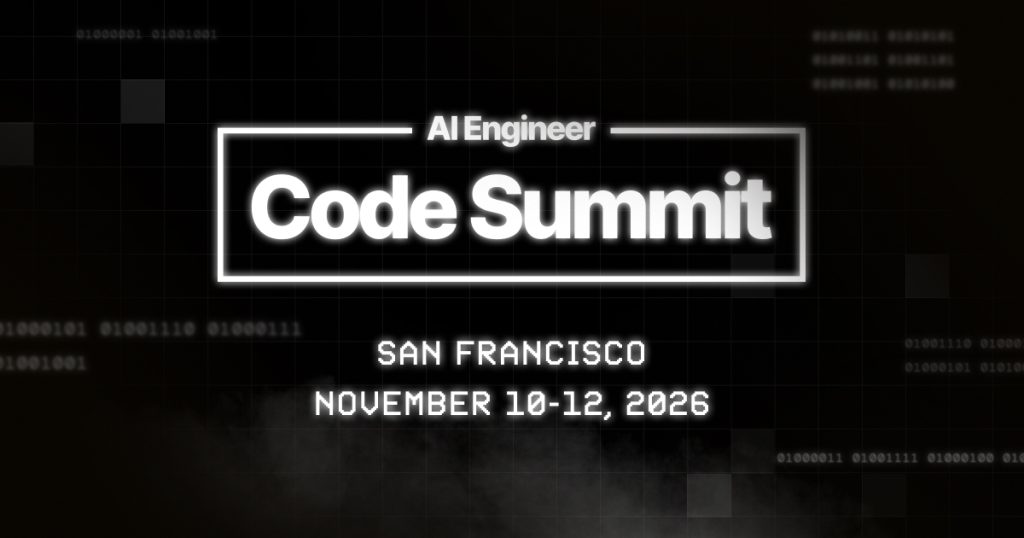
AI Engineer Code Summit 2026 is scheduled for November 10–12 at Hilton Union Square in San Francisco. Organized by AI Engineer, it uses an application-based admission process. Applying is free, but an application does not reserve a place; approved applicants receive a purchase link. The published plan assigns workshops to November 10 and talks plus the expo to November 11–12. This is a specialist event for people already working with the AI coding stack.
Confirmed focus and important program limits
The organizer identifies coding agents, IDE workflows, code review, evaluations, internal agents and agent infrastructure as its program focus. The main sessions are planned as a single track. At the verification date, the complete agenda and 2026 speaker lineup were still being announced. Names shown as past speakers are historical examples, not confirmed 2026 appearances.
That distinction matters when choosing an event for a particular conversation. A developer interested in one specific model vendor should wait for a confirmed session or arrange a separate meeting rather than assume a familiar logo means an engineer from that team will be available. The strongest reason to attend this summit is the concentration on software development workflows.
Who is likely to find it useful?
Engineers building coding agents can use the setting to compare orchestration, tool boundaries and recovery strategies. Engineering managers evaluating a rollout can focus on review burden, maintainability and the difference between faster code generation and faster delivery. Founders building developer tools may find direct conversations about integration constraints more valuable than general market forecasts.
Before applying, write a concise description of one workflow you have actually tried. Include the repository shape, how tasks enter the agent, where humans intervene and what you measured. A concrete experience gives you something useful to contribute. You do not need to disclose private source code or customer information to explain a technical tradeoff.
A practical evaluation plan for the conference
Choose a representative development task and use it as a lens for discussions. A bug fix across several modules, a dependency migration or a test failure investigation is more revealing than asking whether an agent can create a small demo. Ask how systems detect that they are stuck, avoid changing unrelated files and provide evidence that a task is complete.
For code review, distinguish automated comments from verified findings. Useful questions include how false positives are measured, how a reviewer can reproduce a concern and whether the agent has access to the same test environment as the developer. For internal agents, discuss permissions, audit trails and safe recovery from partially completed actions. These are editorial preparation questions; the organizer has not promised sessions answering each one.
Make room for contradictory experiences. A tool that helps one team may be ineffective in another repository because of test coverage, build speed or undocumented conventions. Capture those conditions alongside any success story. A good conference note explains where an approach works and which assumptions would need to hold in your own environment.
Tickets, workshops and remote alternatives
The official page lists a regular talks-and-expo price of US$1,299 plus fees and a US$299 workshop add-on, with a higher final ticket tier also shown. These are published reference prices, not a booking guarantee. Recheck the approved-applicant checkout for availability, taxes, cancellation terms and exactly what is included.
A workshop is worth adding when you can use the required environment and want guided practice, rather than simply collecting another recording. The organizer also points non-attendees toward its livestream and video channel. Confirm the final stream schedule separately; access to videos does not reproduce the conversations and exercises available in a room.
Hilton’s own property page confirms the Union Square hotel at 333 O’Farrell Street. Use that specific property when comparing accommodation and arrival routes; a booking at another San Francisco Hilton does not establish access to this conference venue.
AI Engineer Code Summit FAQ
Can anyone immediately buy a ticket?
No. The advertised process is application-based. An invitation to purchase follows approval, and applying itself does not hold a seat.
Are workshop and conference dates identical?
The preliminary plan places workshops on November 10 and talks plus expo on November 11–12. Confirm the purchased ticket components before arranging travel.
Is the speaker lineup final?
It was not final when checked on October 16. Treat prior-event speaker examples as background only and consult the current official lineup before relying on an appearance.
What should my team bring home?
A useful deliverable is one controlled pilot: a defined task set, a baseline workflow, quality and time measurements, and clear rules for human review. That makes new ideas testable without assuming every conference demonstration will translate directly into production.
Official sources and image credit
- AI Engineer Code Summit 2026 official page — checked 16 October 2026.
- AI Engineer official conference directory — checked 16 October 2026.
- Hilton San Francisco Union Square official venue — checked 16 October 2026.
Image: AI Engineer / Software 3.0 Inc., official 2026 event social graphic. Official source.