Sentaro
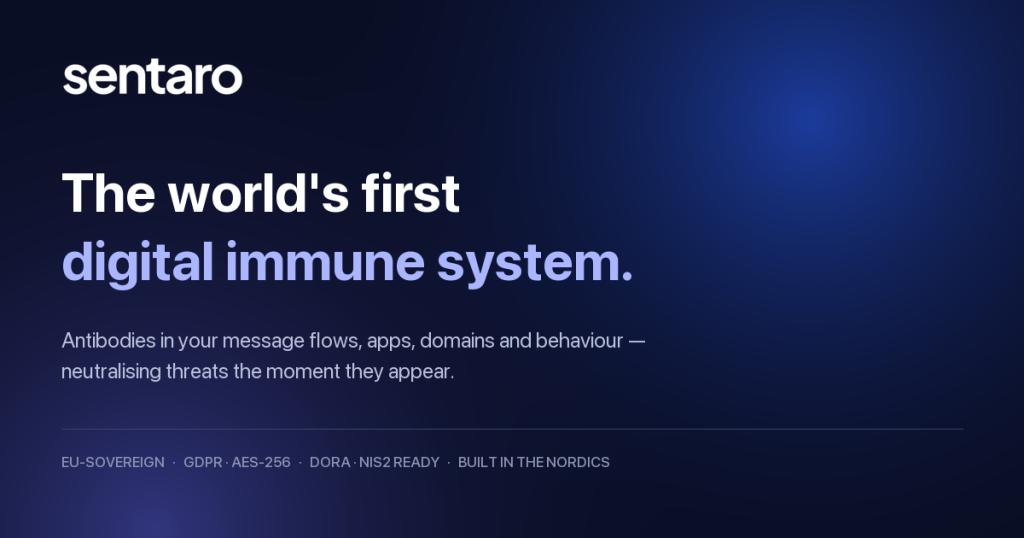
Sentaro uses its own AI engine to score every email, Slack and Teams message and connected app for phishing, impersonation and fraud, with EU hosting in Sweden for regulated European businesses.
What is Sentaro?
Sentaro is an AI-native email and collaboration security service for organisations using Microsoft 365 or Google Workspace. Its own detection engine reads each incoming message for intent, decides whether it is harmless, suspicious or a threat, and acts before the recipient interacts with it. Beyond email, it also watches Slack and Teams messages and the third-party apps that have been granted access to a company's tenant.
The service is run on Microsoft Azure infrastructure in Sweden, with data kept inside the EU. That positioning makes it particularly relevant to European businesses that must evidence controls under rules such as DORA and NIS2, from small teams up to regulated financial firms. Customer logos on the site are mainly Nordic companies and agencies.
Key Features of Sentaro
Message analysis
Every email, Slack and Teams message is scored by AI for who is really asking, where it comes from and whether the request fits the existing relationship. Verdicts are shown as labels in the mailbox, so users see the result next to the message.
App and OAuth monitoring
Sentaro lists every app connected to your tenant together with the data it can reach, including unapproved AI tools and old integrations. Risky grants can be revoked.
Identity and behavioural vectors
Two further vectors are scheduled for general availability in Q4 2026: identity monitoring for leaked credentials and lookalike domains, and behavioural analysis that flags unusual forwarding rules, sessions or data movement against each user's normal pattern.
Automated response
Depending on the verdict, mail is delivered untouched, held inline until verified, or blocked outright. Paid plans add quarantine, forced re-authentication and session revocation.
Fast API deployment
An admin connects the tenant through the Microsoft 365 or Google Workspace API. There are no MX record changes or endpoint agents, and Sentaro states that setup takes about four minutes and can run alongside an existing email gateway.
EU data residency
Data is encrypted at rest with per-tenant keys and TLS 1.2+ in transit, is not used to train third-party models, and verdicts come from Sentaro's own engine. SOC 2 and ISO 27001 certification is listed as in progress.
Sentaro Pricing
Sentaro charges per protected mailbox, and every feature is included in every plan. Shared aliases and distribution lists do not count as accounts. A free tier covering a single account is announced as coming soon; on Pro, the first account stays free.
Prices checked on October 27, 2026; check the official pricing page for current plans.
Who Should Use Sentaro?
- Small and mid-sized EU companies on Microsoft 365 or Google Workspace that want AI phishing protection without a gateway project.
- Finance teams worried about business email compromise and invoice fraud.
- Regulated firms that must document security controls for DORA or NIS2 audits.
- IT admins who want visibility into which apps and AI tools can read company mail.
- MSPs managing several tenants, which Sentaro covers with separate multi-tenant pricing.
Is Sentaro Worth It?
Sentaro's transparent per-account price and API-only setup make it easy to trial compared with many enterprise email security products that hide pricing behind sales calls. Its EU hosting and own detection engine are clear advantages for European organisations with data sovereignty requirements.
Buyers should note that the product is young: the identity and behavioural vectors are not generally available until Q4 2026, the free single-user tier is still marked as coming soon, and SOC 2 and ISO 27001 certifications are in progress rather than complete. Teams outside Europe may find less benefit in its sovereignty focus. For EU businesses wanting AI-driven protection against phishing and impersonation at a modest per-mailbox cost, it is a credible option to test on live traffic.